AI Ads for a Furniture Manufacturer
The brief arrived the way most of ours do: a short message asking whether we could make video ads for a furniture business. No script, no shot list, no number yet on how many videos he needed. Just a factory somewhere in Europe, a product line he was proud of, and a feeling that video would sell it better than photographs.
Eight videos later, he has already booked us for next month, as soon as his new collection comes off the line.
Here is how the project actually ran.
We Started With Questions, Not a Quote
Our first conversation was not about price. It was about where the videos were going to live, who was supposed to watch them, and what he wanted someone to feel after fifteen seconds of furniture.
That conversation changed the brief. He came in picturing one polished company film. What he actually needed was a set: a few wide, cinematic pieces for his website and his trade-show screen, and a handful of vertical cuts for the feeds where most of his buyers already spend their evenings. Same material, different grammar. A shot framed for a widescreen loop does not survive being cropped to a phone, and we would rather plan for that at the start than crop badly at the end.
What He Sent Us, and Why It Mattered
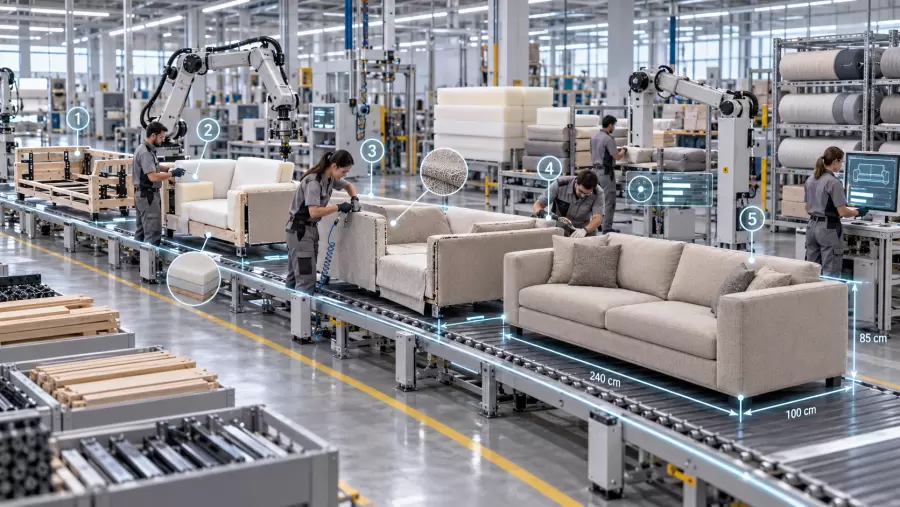
We asked for three things, none of which required a camera crew, a studio, or a day of production stopped: photographs of the production floor, photographs of his workers in their actual uniforms, and photographs of finished pieces from his catalogue. Phone photos were fine.
This is the step people underestimate. AI will happily generate a beautiful furniture workshop out of nothing at all, but it will be a workshop, not his workshop. The machines will be wrong. The light will be wrong. The workers will wear generic overalls instead of the branded ones his customers recognize from the showroom floor. Real reference photos are the difference between an ad for the furniture industry and an ad for his company.
A Free Test, Before Any Money Changed Hands
Before quoting the full project, we made him a short test piece at no cost.
It is a fair thing for a client to want. Nobody enjoys committing a budget to a style they have only had described to them in an email. So we generated still frames first, his workshop and his furniture as they would look rendered through the models, and sent those over. Once he liked the look, we animated a few of them into short clips.
He came back happy, with notes. The characters were not quite right, something in the way the workers looked. We adjusted them, regenerated the stills, re-animated the clips, and sent a second pass. That one landed.
Only then did we scope the real thing: three horizontal videos, five vertical.
Script, Storyboard, Sign-Off
We wrote a rough script and a shot plan and sent it over before generating anything at scale. For the scenes that mattered most, we did not describe them in words. We generated sample frames in Nano Banana and dropped them straight into the document, so he could look at the shot instead of imagining it.
He approved it, with comments. We then went back and tightened everything into a proper shot-by-shot script and a full storyboard covering all eight videos. Another round of discussion, a few more adjustments, and we had a plan nobody was going to argue about three weeks later.
This part of the process is unglamorous, and it is the reason the project did not fall apart.
Generating the Shots
Images came from a mix of tools, because no single one wins at everything. Nano Banana, Grok, and ChatGPT each handled the frames they were best at. The prompts behind them were written with Claude, which is how we keep a room or a character looking like itself across dozens of separate generations instead of drifting a little further with every render.
Then the video pass, on Google's Veo line including the Omni model. Some shots were simple: take an approved frame and bring it to life. Others took real work, blending elements from several reference images into a single scene to build a shot that did not exist in any one frame. Those were the slowest to get right, and they are the ones in the final cut that look expensive.
Assembly in Premiere
Everything went into Adobe Premiere Pro. Generated clips are raw material, not a finished video, and this is the point where the project stops being an AI job and becomes an editing job: trimming, ordering, pacing, cutting the shots that looked great on their own and did nothing in sequence.
Music and voiceover were generated separately, then timed against the edit rather than the other way around. Titles, sound, final polish, eight exported files.
The Revision Round
He had notes. Everyone has notes.
Some videos needed re-editing. In a few, individual moments were regenerated outright, which is one of the genuine advantages of working this way. Reshooting a scene does not mean getting a crew back into a factory and interrupting production for an afternoon. It means running that one shot again.
Second delivery, full approval. He thanked us more than he needed to.
The Part Nobody Puts in a Case Study
Payment went to our European account, and we issued a full set of documents against it.
His accountant filed them without a single question. The videos went onto his books as a legitimate business expense, the same as any other marketing spend, and reduced his taxable profit for the period accordingly. Every company's situation is its own, and his accountant made that call, not us. But the paperwork held up, which is the part we can promise.
We mention it because European clients ask, usually late, and it decides projects. If a supplier cannot invoice you in a form your accountant will accept, the cheap quote is not cheap.
What It Cost Him in Time
One conversation at the start. An afternoon walking his own workshop taking photos. Two rounds of feedback.
That is the entire list. No shooting day, no production halted, no crew in the building, no models, no location fee, no equipment rental, no weather to wait out.
What Happens Next
He is back next month, once the new collection is finished, and we will do it again with a fresh set of photographs.
If you manufacture something physical and you have been putting video off because of what filming it would cost you, this is roughly what the alternative looks like. Send us a few photos and tell us what you are trying to sell. We will show you a test piece before you commit to anything.